Allegion's Commercial Family of Brands















Key control encompasses the policies, procedures and technology used to issue, track, store and audit physical keys and their associated access rights. At its core, key control defines who may hold each key or master key, under what conditions and areas they may use it, and where and how keys must be secured when not in use. By enforcing these rules, key control helps ensure that only authorized personnel can enter specific areas like classrooms, offices, utility rooms, server closets or other restricted spaces, helping prevent unauthorized entry, theft and vandalism.
Beyond managing access, a robust key-control program maintains logs of key issuance and return and co-exists with broader safety measures such as alarm systems, surveillance cameras and emergency response protocols. In this way, key control serves as a foundational layer of physical security that both deters malicious activity and enables rapid, accountable access during routine operations and critical incidents.
Lack of key control can greatly impact a facility where security measures are critical. Hospitals, government buildings, corporate offices, multifamily apartment buildings and schools all rely on strict key control to function properly and protect people and sensitive areas or information. The following examples highlight just how important key control—especially when dealing with master keys and unrestricted keys—is to these facilities.

Problem: The Lost Master Key
In a large corporate office building, a security guard loses a master key to the entire premises, including locked offices holding sensitive information, server rooms and mail centers. The missing key was not reported for several days and was duplicated by unauthorized individuals. The company had to re-key all its locks, which was extremely costly and caused significant operational disruptions.
Solution: Lost keys should be immediately reported. Additionally, sensitive keys like master keys should be restricted keys, meaning they can’t be copied.
Problem: The Duplicated Key
In a multifamily apartment complex, a tenant duplicated their keys to give to a friend to check their mail while gone on vacation. The friend was able to access the package and mail room, which posed a threat to other tenants’ mail and sensitive information.
Solution: In addition to tracking the number of keys given to apartment tenants, the keys should be restricted to avoid unauthorized copying.
Problem: The Supply Thief
A school discovered that several keys issued to staff members had been duplicated and used to access restricted storage rooms. The school had an outdated manual system to track key issuance or usage, making it difficult to identify who was responsible. This led to theft of supplies and prompted the school to implement stricter access control.
Solution: Many schools have older, out-of-patent key systems with open keyways for their doors allowing any key holder to have a copy made at a local hardware store. Key control and tracking, along with the use of restricted keys, particularly on perimeter doors, is important in schools, where many people come and go throughout the day.
The Value of Key Control
Key control is a crucial aspect of security management for all larger secured facilities or campuses:
Effective key control is foundational to a comprehensive security strategy. By combining strong policies, secure technologies and ongoing oversight, organizations can safeguard people, property and information while optimizing operational performance.
Knowledge Checkpoint: Key Control

Types of Key Management Systems
Key management systems are designed to organize, control and monitor access to keys within an organization. There are several types of key management systems, each suited to different security needs. Choosing the right system depends on your security requirements, facility size, budget and operational complexity.
First, there's a physical place—commonly a cabinet, a key rack or other type of location—where keys can be stored. Even basic storage should be secured: the cabinet or room should itself be locked and access limited to designated staff. More advanced storage solutions include tamper-resistant cabinets and electronic key cabinets that require user authentication to open; regardless of type, physical protection of the storage location is a foundational layer of key control.
There are a variety of methods for tracking keys, from handwritten logs to spreadsheets and dedicated key control software. Each method has trade-offs. Handwritten logs are simple and low-cost, making them easy to implement immediately, but they are prone to human error, illegible or incomplete entries, and do not provide a reliable audit trail. Spreadsheets are familiar and inexpensive and allow searchable records and basic reporting, yet they still rely on manual data entry, are vulnerable to accidental deletion or versioning issues, and lack real‑time control. Key control software provides digital tracking and reporting tools to be paired with physical storage, delivering detailed keyholder information, tracked key issuance and returns, and generated reports to help manage the key system. While they can greatly improve accountability and reporting, they require an upfront software purchase or subscription, initial configuration and staff training.
Finally, the highest level of control and security stems from electronic access control (EAC) using cards, biometrics or other credentials paired with electronic locks and management software. These automatically track users and usage, provide real-time status and comprehensive audit trails and can integrate with other systems for coordinated usage and responses. While EAC systems typically involve higher upfront costs, ongoing maintenance and user training, they are particularly well suited for larger facilities with complex access needs, frequent personnel turnover and strict accountability or compliance requirements.
Challenges and Considerations
When implementing a key management system, it's important to consider potential challenges and operational factors to ensure the solution effectively meets your building's security needs and budget constraints.
Best Practices for Effective Key Control – Are you tracking every step?
A key system life cycle refers to the complete process of managing physical keys from creation to retirement. It includes all stages that a key goes through to ensure security, accountability, and efficient use. The typical stages are:
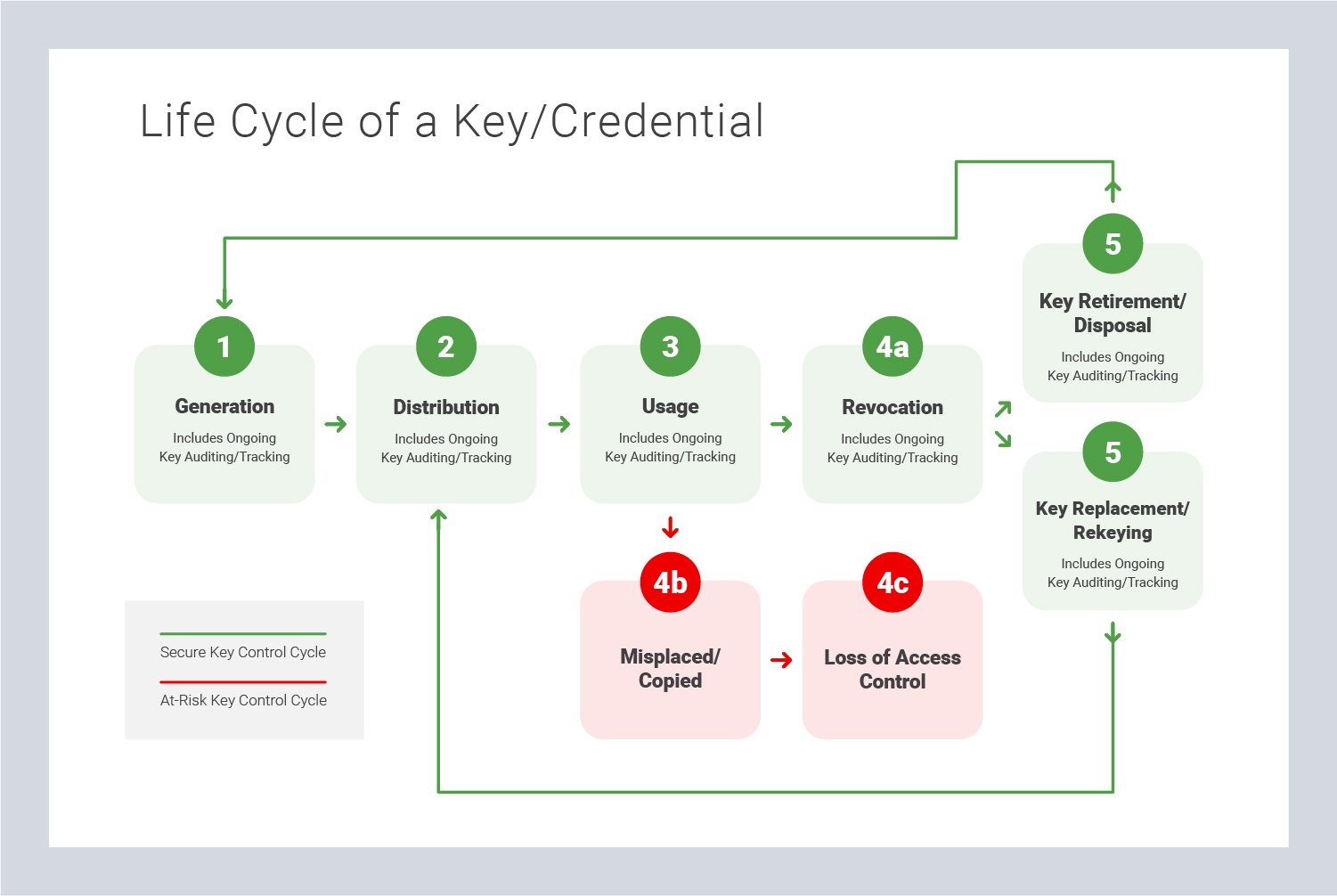
Do you have complete control of your keys? Keys and credentials move through several phases in their life cycles, making it difficult to control them. Implementing robust key control practices is essential to maintaining security, accountability and operational efficiency throughout one or multiple facilities. This starts with keeping detailed records of key issuance and returns, including who received the key, when and for what purpose. Regular audits help verify key inventories and detect any irregularities. Clear policies should define key holder responsibilities, issuance and return procedures, and consequences for misuse.
To prevent loss and theft, have immediate reporting processes for missing keys and promptly rekey or replace locks if security is compromised. Using restricted or patented key systems limits unauthorized duplication and enhances security. Training staff on key control policies and handling procedures is essential. Access permissions should be reviewed regularly and updated to reflect personnel changes. Limiting key distribution to only necessary personnel reduces exposure and strengthens control.
Key Takeaways

Explore our extensive Resources hub to find a complete collection of tools and information to assist and guide you along your journey.
Contact us today to talk about your project needs.
Ⓒ 2025 Allegion all rights reserved